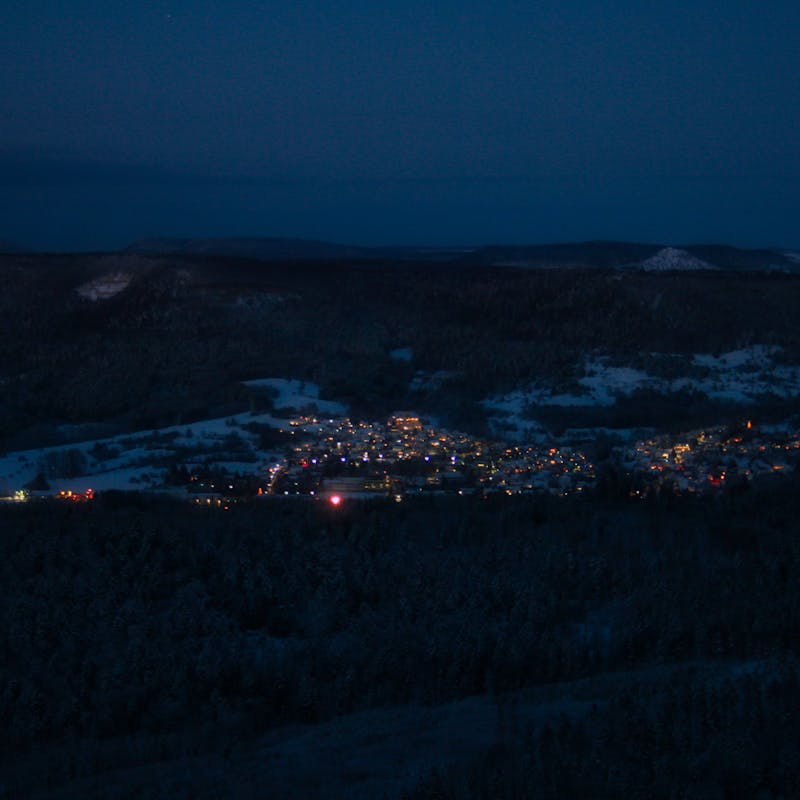
Some places don’t vanish; they simply stop being spoken aloud.
The first thing you notice is the quiet. Not the kind that belongs to snow or empty deserts, but a quieter quiet—one that feels practiced, as if the streets have learned how to hold their breath. In the town that forgot its name, silence doesn’t signal absence. It signals memory.
People still live here. Lights still turn on behind curtains. Someone still waters a leaning row of potted plants outside a corner storefront that sells nothing you can name on a receipt. And yet, ask any resident what the town is called and you’ll get an answer that slips sideways.
They’ll say, “Here,” like that’s sufficient.
Or they’ll point across the road, as if the name is posted somewhere you can’t see.
Or they’ll give you a word that sounds almost right—close enough to be recognizable, but not quite stable in your mouth.
When a Name Stops Working
A town’s name is supposed to be an anchor. It belongs on maps and envelopes, in news headlines and school fight songs. It’s the word you say when you tell someone where you’re from, the shortcut that turns a life into a location.
But names are only as strong as the stories that keep repeating them.
Over time, this town’s story got interrupted. The factory closed, or the river changed its mind, or the highway curved away like a hand withdrawing. The specifics vary depending on who you ask, and that variability is part of the point. When a place loses the steady rhythm of being needed, it can lose the steady rhythm of being named.
Mail still arrives, somehow. Deliveries come with instructions like “third house past the old movie theater,” even though the theater is now a shell with a faded marquee and a door that doesn’t open. Directions become a kind of folklore.
The name—whatever it used to be—begins to feel too sharp for what remains.
Life in the Soft Middle of Things
In a town without a stable name, people lean harder on patterns. You can feel it in the way mornings happen.
A woman opens the diner at the same hour every day, turning the sign from Closed to Open with the patience of someone keeping a promise to an audience she can’t quite count on. A few regulars arrive not because they’re hungry, exactly, but because their bodies know where to go when the day starts.
In places like this, routine becomes a form of identity. If you can’t say the name of the town with confidence, you can say, “I’m the one who unlocks the door,” or “I’m the one who sweeps the steps,” or “I’m the one who remembers which houses have dogs that bark and which houses have dogs that don’t.”
The heartbeat of the town is less about announcements and more about tiny confirmations.
A nod at the gas pump.
A wave from a passing truck.
A familiar laugh cutting through the quiet like a match struck in the dark.
The Echoes Between Heartbeats
The phrase sounds poetic until you’ve stood still long enough to hear it.
Most towns have a steady noise floor. Even at night, there’s the hum of traffic or the distant churn of commerce. Here, the spaces between sounds are longer. You can hear the interval between one dog’s bark and another, between a car door closing and the engine starting.
Those intervals do something to you.
They make you aware of your own body—of the small internal metronome you carry everywhere. Your heart keeps time even when the world forgets its schedule. In the quiet, you begin to notice how much of modern life is designed to drown out that awareness.
In the town that forgot its name, the gaps become loud.
You hear the echo of a conversation you had ten years ago, the one you thought you’d outgrown.
You hear the echo of a person you miss, not as a sharp grief but as a gentle pressure, like weather changing.
You hear your own thoughts, unbuffered.
The town doesn’t provide entertainment so much as it provides acoustics.
What Happens When Maps Don’t Agree
There’s a practical problem, of course. A name is a coordinate. Lose it and you lose a certain kind of legitimacy.
Outsiders get confused. GPS devices do their best but sometimes send you to a field. Government forms insist on a city line that doesn’t match how residents think about their boundaries. News reports about the region use other towns as reference points, as if this place is only understandable through its neighbors.
And yet, the absence of a firm name also creates a strange freedom.
If you can’t pin the place down with a single word, you start describing it with feeling. You say, “It’s the town with the river that looks like tin in the afternoon.” You say, “It’s where the air smells like cut grass and old paper.” You say, “It’s the place where my grandfather’s hands were always stained from work.”
In that way, the town becomes a collection of human measurements instead of official ones.
Not longitude and latitude.
But porch lights.
But the sound of screen doors.
But the way the shadows fall across Main Street at 5:30 in July.
The Gentle Conspiracy of Remembering
It’s easy to assume the town forgot its name by accident, like a person misplacing keys. But forgetting can also be a choice made slowly.
Names carry histories, and histories carry arguments.
Maybe the town’s original name came from a land deal that never sat right, or a family that profited while others struggled. Maybe it honored someone whose reputation aged poorly. Maybe it was a word from another language that got misspelled, flattened, and eventually felt like an insult.
In those cases, forgetting can be a kind of quiet protest. Not loud enough to make headlines, but persistent enough to change the way people speak.
Even if no one agrees on why the name disappeared, they share a subtle understanding: saying the wrong name can feel like stepping on a weak floorboard. Better to step around it.
So they do.
They speak in landmarks and nicknames. They let the town exist without demanding it justify itself through a label.
The Newcomer’s Instinct to Fix Things
If you arrive from somewhere that prides itself on clarity—where brands are strong and neighborhoods are marketed like products—this town can make you restless. You may want to solve it.
You might think: We should put up a sign.
Or: We should start a petition.
Or: We should pick something and commit to it.
That instinct comes from a good place. Names help people feel grounded. They help places receive resources, get recognition, attract attention.
But there’s another possibility.
What if the town’s unnamed state is not a problem to be corrected, but a condition that reveals something true about community?
When a name fades, people can no longer rely on the easy shorthand of belonging. They have to show it. They have to prove, in small repeated ways, that they are part of the same ongoing story.
Belonging becomes less declarative and more lived.
The Weight of a Place You Can’t Summarize
There’s a certain kind of question people love to ask: “What’s it like?”
It sounds friendly, but it assumes that experience can be distilled. That a town can be summarized like a movie review.
In the nameless town, “What’s it like?” is harder to answer.
It’s like knowing the cashier’s kid just left for college and pretending not to watch the mother’s face when she hears the door chime.
It’s like driving past a house where someone used to sit on the porch every evening, and noticing the porch is empty, and feeling that emptiness register in your chest.
It’s like hearing a church bell once a week and being unable to tell if it’s calling you to worship or simply telling you that time is still moving.
Places without names don’t lend themselves to summaries.
They linger.
The Heartbeat as a Local Language
Over time, you realize that the town hasn’t lost language entirely. It has shifted to a vocabulary of rhythm.
When the diner gets busy, when the school lets out, when the hardware store has a rush before a storm—these are pulses. They are communal heartbeats. People anticipate them the way you anticipate a familiar song.
And in the spaces between those pulses, life becomes intensely personal.
Someone sits in a parked car and doesn’t turn the key right away.
Someone walks their dog slower than necessary.
Someone stands at the edge of a field, listening, as if waiting for an answer.
The town speaks in intervals. It teaches you to pay attention to what happens when nothing is happening.
The Name That Lives in the Body
Eventually, you stop trying to retrieve the missing word. You begin to understand that the town’s name might not be a sound at all.
It might be the way your shoulders drop when you cross the bridge.
It might be the mild dread you feel on Sunday evenings, not because of work but because the week threatens to pull you away from the fragile coherence you’ve found here.
It might be the smell that hits you when you open your front door after rain—earthy, metallic, alive.
The name might be embedded in your nervous system.
And maybe that’s why it’s hard to say aloud.
A Place That Keeps Listening
The town that forgot its name doesn’t demand to be noticed. It doesn’t sell itself. It doesn’t perform identity for outsiders.
Instead, it listens.
It listens to the slow traffic of everyday life. It listens to grief that never got public language. It listens to small joys that would sound silly if you tried to explain them at a party.
And if you stay long enough, you start listening too.
Not for the missing word on the sign.
But for the echoes between heartbeats—the moments when the world pauses and you can feel, with startling clarity, that you are here.
Not in a named place, exactly.
But in a real one.