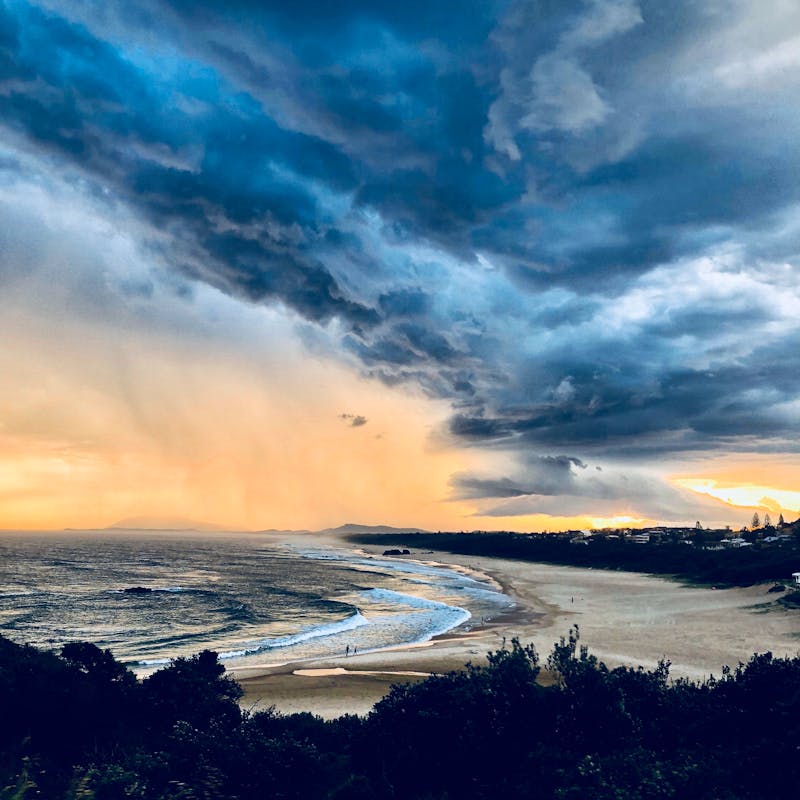
The weather has started to feel like a message.
Not in a mystical way, not like a coded prophecy hidden in cloud shapes. More like the quiet realization that the background hum of life—seasons, rain, the dependable rhythm of days—has become a little less dependable. You notice it the way you notice a familiar song played in the wrong key.
For many of us, the story of a warming planet arrives indirectly.
It shows up in a longer allergy season that makes a simple walk feel like a chore. It shows up when an elderly neighbor checks the heat index like it’s a new form of etiquette. It shows up in the small talk at the grocery store: “Can you believe it’s this hot already?” The question isn’t really a question. It’s a recognition.
These are notes from the margins—where most of us live.
Not in laboratories or policy rooms, not at the microphone. In the in-between spaces of ordinary life, where climate change becomes less a headline and more a texture.
When the ordinary stops being ordinary
There was a time when the weather felt like a reliable character in the story of a place.
You knew what kind of winter you were going to get. You knew when to expect the first truly hot day. Even if the forecast was wrong, the arc of the season made sense.
Now, the surprises are sharper.
A warm spell in February that feels like a stolen afternoon. A week of smoke that turns the sky the color of bruised metal. Rain that arrives not as a steady, nourishing presence but as a burst—too much, too fast, and then nothing for too long.
The mind tries to normalize it.
We tell ourselves it’s just “a weird year,” because that’s how human beings protect their sense of stability. But the weird years keep stacking. And eventually the stack becomes a pattern, the kind you can’t unsee.
It’s not only the extremes that change us.
It’s the subtle redefinition of what “normal” means, and how quickly that redefinition happens. You look back five or ten years and realize your baseline has shifted. The season you remember becomes a season you miss.
The quiet grief of noticing
There’s a particular kind of sadness that comes with paying attention.
It isn’t the dramatic grief of a single disaster, though disasters are part of the story. It’s the slow grief of realizing that some things are slipping away without a clear moment of loss.
A childhood memory of snow that stayed for weeks.
A family lake that used to freeze solid.
A spring that smelled different—less damp earth, more heat.
You feel it when you see fewer insects around porch lights.
You feel it when birds show up at odd times, or not at all. You feel it in the way gardens demand new strategies, new timing, new varieties, as if the old rules have been quietly revoked.
This grief often hides behind humor.
People joke about needing a “second summer wardrobe” or running the air conditioner earlier every year. Jokes are social armor. They let us name what’s happening without admitting how much it affects us.
Grief can also come with a kind of guilt.
If you’re not the one losing a home to a fire or a flood, if you’re not in a place where the heat is deadly for weeks at a time, you may hesitate to claim any sadness at all. But paying attention is not a competition. The emotional landscape is not a zero-sum map.
Sometimes the first step toward seriousness is allowing yourself to feel what you’ve been trying to shrug off.
A warming world is a world that pushes back
Climate change is often described as something we are doing to the planet.
That’s true, but incomplete. The fuller truth is that a warming world pushes back—into our routines, our infrastructure, our assumptions, our bodies.
Heat changes behavior.
It changes how long kids can play outside without adults hovering. It changes the way cities sound at night, when air conditioners thrum like a chorus. It changes the pace of work for people whose jobs are outdoors, where “toughing it out” becomes a health risk rather than a virtue.
Water changes politics and intimacy.
In some places, drought makes neighbors suspicious. In others, floods turn strangers into a temporary community, hauling soaked furniture to the curb and swapping extension cords like favors.
Insurance becomes a kind of weather report.
Premiums rise, coverage narrows, and certain disasters stop feeling hypothetical. In the margins, you hear it as a throwaway line: “They won’t insure that area anymore.” It lands with the weight of a verdict.
Even food becomes a conversation with the climate.
Prices shift with harvests. Certain items feel less consistent—smaller, bruised, scarce. You start to notice how far your lunch traveled, and what it required along the way: irrigation, refrigeration, trucking routes that assume stable roads and predictable storms.
The world pushes back in ways that are both practical and psychological.
We are accustomed to thinking of nature as scenery. But scenery doesn’t usually interrupt meetings, cancel flights, or trigger health alerts. When the background starts affecting the foreground, the story changes.
The waking world: attention spreads
Alongside the warming, there’s a waking.
Not a sudden enlightenment, not a single unified movement. More like a gradual, uneven opening of eyes. People who never used to talk about climate now mention it casually, as part of life’s logistics.
The waking happens in unexpected places.
A contractor recommending different materials because the summers are harder on roofs now. A school district adjusting sports schedules around heat. A friend who used to roll their eyes at “green stuff” suddenly installing shade trees and asking about insulation.
It’s not always ideological.
Often it’s practical. Most people come to climate awareness the way they come to any difficult truth: through experience, through repetition, through the slow accumulation of evidence that doesn’t leave.
The waking also includes a new literacy.
Words like “heat dome,” “smoke season,” and “hundred-year flood” have entered everyday speech. We’ve learned to read air quality indexes like we read traffic. We keep mental lists of evacuation routes, backup plans, and friends who have generators.
There’s something sobering about how quickly we can adapt.
Adaptation is a human strength, but it can also become a trap. If we adapt too easily, we risk accepting what should never have become normal. The waking world has to balance resilience with refusal.
Living in the margins means living with contradictions
Most people are not pure in their choices.
You can care deeply and still take flights. You can be worried and still forget your reusable bags. You can believe in systemic change and still feel overwhelmed by the tangle of daily life.
The margins are where contradictions live.
You might bike to work and then order something shipped overnight. You might compost and still drive because the bus schedule doesn’t match your shift. You might want to make big changes and discover that your building’s landlord controls the heating system and doesn’t want to hear about it.
These contradictions can breed cynicism.
If you can’t do everything, why do anything? If leaders won’t act, why should you? If the problem is huge, why bother with small choices?
But the margins are also where culture shifts.
They shift through repeated, imperfect actions that signal new expectations. They shift when a neighborhood treats shade and tree cover as essential rather than decorative. They shift when people ask harder questions about what’s being built, where, and for whom.
Small decisions don’t replace policy.
Yet they can create the social conditions that make policy possible. They can also keep us from sliding into numbness, which is its own kind of surrender.
The shape of responsibility feels different now
There’s an older version of environmental responsibility that sounds like moral housekeeping.
Turn off lights. Recycle. Don’t litter. These habits still matter, but they don’t match the scale or complexity of the moment.
Responsibility now includes attention.
It includes learning what’s happening where you live, not as trivia but as context. It includes knowing who is most exposed to heat, flood, and pollution—and why. It includes noticing that the burdens of a warming world are not evenly distributed.
Responsibility also includes community.
A neighbor checking on a neighbor during a heat wave is not a symbolic act. It’s climate action in its most human form. A library staying open as a cooling space is not just a service; it’s a lifeline.
Even conversations can be a kind of infrastructure.
Talking honestly about what’s changing can loosen the grip of denial and isolation. It can replace vague dread with shared clarity. It can help people feel less alone in what they’re noticing.
And responsibility includes imagination.
Not the glossy kind that sells a perfect “green future,” but the grounded kind that asks: What would it look like to design our towns and habits around the world we actually have, while still fighting for the world we want?
The future arrives as a series of Tuesdays
It’s tempting to picture climate change as a single dramatic turning point.
One day we’ll cross a line, and everything will be different. But lived reality is more incremental. The future shows up as a series of Tuesdays—ordinary days when you make choices inside constraints.
You decide whether to plant a tree.
You decide whether to support a bond measure for better infrastructure.
You decide how to talk to your kids about smoke and heat without handing them despair.
You decide whether to treat extreme weather as isolated bad luck or as information.
This is where the margins matter.
Because the margins are where habits form and where meaning is made. They’re where people decide what’s acceptable, what’s intolerable, what’s worth changing.
A reflective note, written in pencil
A warming world can make you feel small.
The scale is enormous, the timelines are long, and the systems involved—energy, politics, economics, culture—can feel immovable. But there’s another truth that lives alongside that smallness.
The world is waking because people are noticing.
Noticing is not the same as fixing, but it is the opposite of sleepwalking. It’s the start of accountability. It’s the seed of solidarity. It’s how private unease becomes public demand.
Maybe that’s what it means to write from the margins.
To admit that you’re not in charge of the whole story, but you are responsible for your part of the page. To keep track of what’s changing, not with panic, but with clarity. To stay soft enough to feel it, and steady enough to respond.
The weather feels like a message because it is.
The question is what we do with it once we’ve read it—and whether we can learn to answer in a voice that’s bigger than any one of us, but made of all of us together.