Some sounds don’t just fill a room—they open a door.
Rain against glass has that kind of power. It doesn’t demand attention like thunder or wind. It arrives as a steady, intimate tapping, as if the weather itself is trying to speak softly enough not to startle you. And when it lands on a window—close enough to see, close enough to count—you begin to notice how many worlds can exist at once, separated by nothing more than a thin pane and a few degrees of warmth.
Inside, there’s a lamp’s amber circle, a mug cooling on a table, the hush of fabric and carpet absorbing sound. Outside, the street has a shine to it, a moving mirror that catches headlights and streetlamps and turns them into long, trembling ribbons. Between those two scenes is the window, that ordinary boundary we almost never think about until weather makes it visible.
The window as a quiet border
A window feels like an invitation, but it’s also a limit. It’s where the mind goes when it doesn’t want to go too far.
You can look out and see everything, but you can’t step into it without consequences. The cold waits on the other side. The wet. The unpredictability. That’s part of what makes the view so seductive: it’s safe to observe from here.
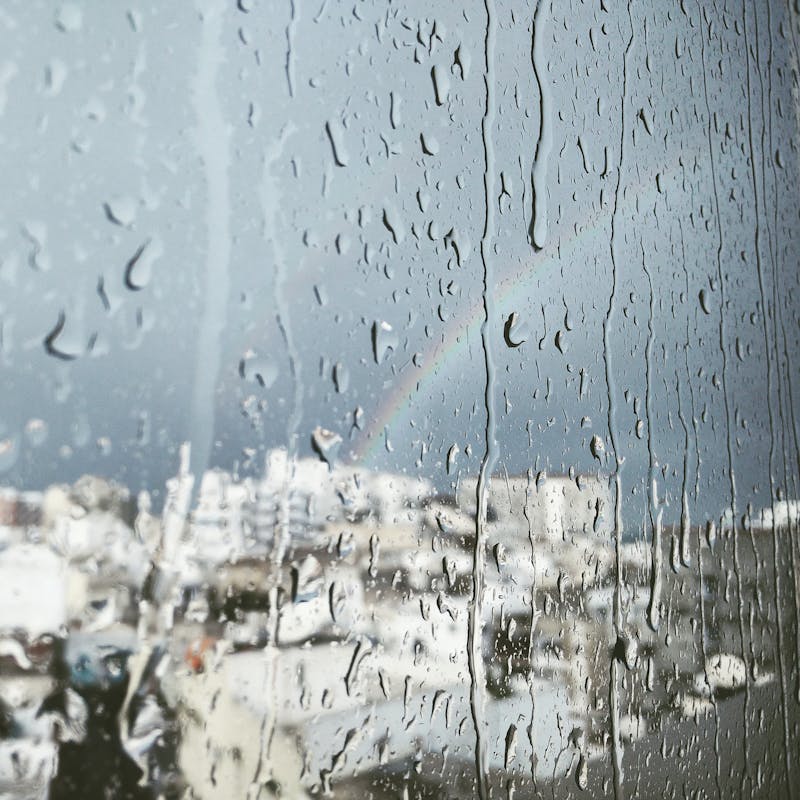
On rainy nights, the glass becomes an active participant. Droplets gather, hesitate, then slide. They bend the view into a living watercolor, turning sharp corners into soft shapes. The world outside is still there, but it’s translated—slightly distorted, slightly gentler.
That translation matters. It changes what you think you’re seeing. A couple walking past isn’t just a couple; they’re two silhouettes under one umbrella, a small moving island. A tree isn’t just a tree; it’s a darker stain against a gray sky, its branches scribbling in the distance.
The window makes everything into a story you can’t quite verify.
Soft rain and the pace of thought
Soft rain doesn’t raise your heart rate. It lowers it.
There’s a reason it pulls people into reflection. Its rhythm is consistent enough to become a background, but varied enough to keep you from tuning it out completely. The mind, relieved of urgency, begins to wander in a more honest way.
You notice the small things you usually skip: the way the room smells after the first drops, the faint metallic edge in the air, the way light feels more local, more personal. The day’s noise seems to retreat. Even a city, under rain, quiets its surfaces. Tires hiss instead of roar. Footsteps soften. Conversations retreat indoors.
In that slowing, you start to see the worlds between you and other people.
Not in a dramatic, tragic sense, but in the everyday reality that each person is a whole weather system. We share sidewalks and meetings and group texts, yet we remain separate climates—our own pressures, our own shifting fronts.
Rain makes this easier to feel because it makes separation visible.
The worlds between us aren’t always distance
The phrase “worlds between us” sounds like miles, oceans, time zones.
Sometimes it is. Sometimes it’s a relationship stretched thin by logistics, or a family that lives in different seasons. But more often, the distance isn’t geographic. It’s interpretive.
Two people can stand in the same kitchen and inhabit different realities. One hears a comment as harmless. The other hears it as a pattern. One thinks they’re offering help. The other feels managed. The space between them is not a lack of love; it’s a mismatch of meaning.
Soft rain on the window becomes a metaphor not because it’s poetic, but because it’s accurate. The window shows you how easy it is to be close and still separated by something transparent.
The boundary is real, but it’s also thin.
And that’s the complicated part: thin boundaries can be harder than thick ones. When the divide is obvious—an argument, a breakup, a move—you can name it. But when it’s nearly invisible, you keep pressing your hands against it, wondering why you can’t get through.
How we learn to live with separation
Most of adulthood is learning to accept that you cannot fully enter another person’s interior world.
You can listen. You can ask good questions. You can become fluent in their habits and their history. You can learn the landscape of what makes them withdraw or soften or light up. But you still remain yourself.
That sounds bleak if you frame intimacy as total access.
But there’s another way to see it: the separation is what makes meeting meaningful. If there were no boundary, there would be no crossing. No arrival. No moment when a sentence lands just right, when a friend understands you without you having to translate, when someone reaches for your hand in the dark and finds it.
Those moments matter because they are not automatic. They’re made.
Rain helps you sense this because it creates a gentle insistence: you can’t control what’s outside, but you can choose how to be inside. The boundary pushes you toward agency.
You can keep the lights off and let the evening feel heavy. Or you can turn on a lamp and make a small harbor out of your room.
The hidden comfort of being indoors
There’s a small, private pleasure in watching rain while staying dry.
It’s not schadenfreude or laziness. It’s relief. It’s the body recognizing shelter.
When you’re inside during a storm, you feel the architecture doing its job. The roof, the walls, the glass—things you forget to appreciate until they become the reason you’re comfortable. In a subtle way, it reminds you that your life is supported by structures you didn’t personally build.
That realization can be humbling.
It can also be comforting, especially when the worlds between people feel too wide. You might not be able to fix the misunderstanding, rewrite the past, or make someone meet you where you are. But you can do something smaller and real: create a place where you can think, rest, and try again tomorrow.
Soft rain turns that shelter into something almost sacred.
You can sit near the window, close enough to see the droplets merge and split, and feel as if the world is telling you that change doesn’t always look like a dramatic shift. Sometimes change is incremental. A thousand tiny impacts. A slow reshaping.
Memory’s strange weather
Rain has a way of stirring memory without permission.
A scent will pull you back to a porch light. The sound will return you to a car ride where everyone was quiet for different reasons. The view will remind you of the evening you waited for someone to text and watched the street outside turn glossy and black.
What’s odd is how rain doesn’t always bring back the big moments.
It brings back the in-between moments—the pauses, the waiting rooms of life. Times when you didn’t know what would happen next, when you were suspended between versions of yourself.
Those are the worlds between us too: the selves we used to be, the selves we might become, the selves we show people, and the selves we keep private.
Soft rain makes that layering feel closer to the surface.
You can almost see it in the way reflections appear on the glass: your face faintly superimposed over the street, your room’s light floating over the darkness outside. Two images at once. Neither one is the full truth, but together they feel more honest.
The language of what we don’t say
There are conversations that happen without words.
A person pauses before responding. Someone looks away at the wrong moment. A friend says they’re fine, and the tone carries a different sentence underneath. We live in these half-spoken spaces more than we admit.
The worlds between us are often built from what we can’t quite articulate.
Not because we’re deceitful, but because language is limited. Feelings don’t arrive labeled. Motives are mixed. Fear can look like indifference. Pride can look like calm. And sometimes we don’t speak because we’re trying to protect the other person from our own confusion.
Soft rain on the window offers a kind of permission.
It suggests that not everything has to be resolved immediately. It gives you a backdrop for patience. The droplets don’t rush to the bottom; they move when they’re ready, pushed by gravity and the merging of smaller pieces into something heavy enough to travel.
That’s how some truths work too.
When distance becomes a choice
Not all separation is accidental.
Sometimes the worlds between us are carefully constructed because closeness is risky. Letting someone in means handing them the ability to hurt you, even if they never use it. It means being seen in a way you can’t control.
So people keep a pane of glass between themselves and everyone else.
They show enough to appear open, but not enough to be vulnerable. They become experts at pleasant conversation, at competence, at being “low-maintenance.” And from the outside, it can look like strength.
But soft rain reveals how lonely a boundary can be when it’s always there.
Because a window is only comforting if you can open a door somewhere else. If there’s no way out, it becomes a barrier you start to resent.
Rain doesn’t solve this, of course. But it can make you ask a better question than “Why am I like this?”
It can make you ask, “What am I protecting?”
A quieter kind of closeness
There’s a version of intimacy that doesn’t require constant talk.
It’s two people in the same space while the rain moves over the building. It’s the mutual agreement that you don’t need to fill every silence. It’s the ability to sit with the world as it is—unfinished, imperfect, still in motion.
This kind of closeness is less about merging worlds and more about honoring their difference.
You don’t have to collapse the space between you. You just have to make it navigable.
That might look like checking in without demanding a performance. It might look like apologizing without turning it into a courtroom. It might look like saying, “I’m not sure what I feel yet, but I want you to know I’m here.”
Those are small bridges, but they hold.
The rain keeps falling, and you keep living
Eventually the rain thins.
The tapping becomes intermittent, then stops. The street loses its mirror shine. The window begins to look like a window again, plain and unobtrusive. And the world resumes its ordinary insistence.
But something lingers.
The sense that separation is both inevitable and negotiable. The awareness that boundaries can protect and isolate at the same time. The reminder that you can be warmed by shelter without forgetting the weather outside.
Soft rain on the window doesn’t erase the worlds between us.
It simply makes them visible for a while, like a pencil sketch revealed under the right light. And in that visibility, there’s a chance—quiet, unforced—to choose what you’ll do with the space.
Not to conquer it. Not to pretend it isn’t there.
Just to live with it more consciously, and maybe, when you’re ready, to open something that’s been shut for too long.