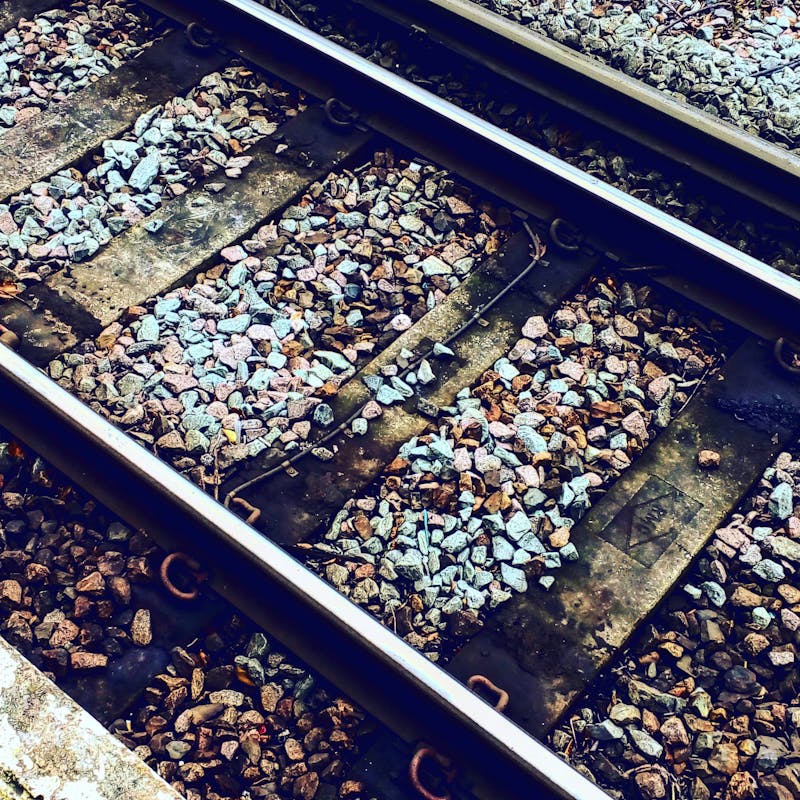
Some places don’t speak; they murmur, patiently, until you learn how to listen.
Where the pavement gives up
At the edge of town, the streetlights thin out like people leaving a party too late.
The sidewalks fracture into gravel. Chain-link fences lean with the tired confidence of things that have stood through too many summers. And then, almost without announcement, you find the train tracks—two steel lines moving forward with a certainty the rest of the neighborhood seems to have misplaced.
There’s usually a strip of wildness beside them, a narrow border where city planning loses interest. Tall weeds, stubborn saplings, a ditch that holds rainwater in spring and dry trash in August. It’s not picturesque in the postcard sense. It’s something more complicated: a practical scar that has become a habitat.
If you’ve lived in a town long enough, you know this place even if you rarely visit it. Everyone does. It’s where you drive past without looking, or where you went once in high school because someone said it was “quiet” and meant it the way teenagers mean quiet—charged, private, watchful.
The special kind of silence trains create
Train tracks are never truly silent.
Even when there isn’t a train, there’s the faintest suggestion of movement. Metal holds memory. The rails expand and contract with temperature, making noises like knuckles cracking. Gravel shifts underfoot. Wind slides through the corridor the tracks have cleared, and it sounds different there, as if it has more room to stretch.
You might hear a far-off horn long before you see anything.
It arrives not as a single note but as a layered warning, bouncing off warehouses, water towers, and the backs of houses that face the tracks like people who don’t want to be seen watching. In that sound is a strange authority: the reminder that this line belongs to something larger than the town.
Even a stationary crossing has its own rhythm. The red lights blink when a train comes, but the machinery is always ready. A little box by the road hums, a quiet vigilance. The arms are poised like folded hands.
Some people find this unsettling. Others find it oddly comforting.
Because trains keep promises. They arrive, they pass, they leave. The schedule might change and delays might happen, but the idea of the train is reliable in a way most of modern life isn’t. It doesn’t ask you to refresh. It doesn’t require a password. It is heavy and real.
A boundary line you can walk across
The edge of town is rarely marked with a sign.
It’s more like a mood shift. The last coffee shop gives way to a shuttered auto body place. The tidy lawns loosen their grip. The air smells different—less cut grass, more dust, maybe a hint of creosote from old ties warming in the sun.
Tracks make a boundary you can see.
On one side, there are addresses and routines and mail delivery. On the other, there might be nothing but brush, a service road, and a sense that you’ve stepped into the part of the town that isn’t meant for living in, only for moving through.
That’s the paradox. The tracks exist to carry things away and bring things in, yet they often sit beside neighborhoods that feel left behind.
A town’s edge tells a quiet truth about what it values. The nicer developments usually aren’t built up against the rails. You don’t put a new playground where freight cars rattle at midnight. You don’t market “rail-adjacent living” unless you’re selling a romantic idea in a city where trains are quaint.
In many towns, the tracks are where industry used to be.
Warehouses half-occupied. A brick building with painted letters fading into the wall, a company name no one remembers. Sometimes the tracks look newly maintained; sometimes the weeds suggest they’re used just enough to justify their existence.
Standing there, you can feel how a place changes its mind over time.
The stories people tuck into the margins
Every town has a small mythology around the tracks.
There’s the story of the kid who walked them at night and swore he saw a light moving toward him with no sound. The rumor about a shortcut only locals know, cutting behind the lumber yard and across the ballast to get to the river.
Older residents might tell you about the days when passenger trains stopped here, when the station had a waiting room and the platform was swept clean. They’ll mention a relative who left for a big city with one suitcase, the kind of departure that becomes family legend.
The tracks collect these stories because they’re a physical symbol of elsewhere.
In a small town, “elsewhere” can be intoxicating.
Not necessarily because the town is bad, but because repetition can feel like gravity. The same faces at the grocery store, the same roads, the same conversations about weather and school sports and property taxes. The tracks suggest that another life is passing by, close enough to hear.
Sometimes you see someone sitting near the rails, just watching.
Not doing anything, not taking pictures, not making it perform for social media. Just looking down the line the way people look at the ocean. The horizon is different here—straight, narrow, purposeful.
It’s easy to read that as sadness.
But it can also be a form of rest. A moment when you let your mind move without having to move your body. A private pause that doesn’t need to be explained.
Freight trains and the language of the night
If you live near the tracks, you learn the train’s vocabulary.
There’s the polite rush of a faster train, a long exhale that fades quickly. There’s the slower freight, which doesn’t so much pass as occupy. It changes the whole neighborhood’s soundscape, adding a low vibration that makes cupboards subtly rattle.
At night, the train can feel intimate.
You might be lying in bed when the horn sounds—two long, a short, a long—repeated at each crossing. It’s a pattern meant for safety, but it becomes a kind of nighttime refrain, like a distant singer practicing the same phrase.
The freight cars themselves are like moving buildings.
Graffiti flashes by in quick, bright bursts, a gallery nobody asked for but everyone notices. A rusted ladder. A stencil number. A patchwork of metal panels that have been repaired and repainted, showing their history in mismatched squares.
And then there’s the moment when the train stops.
That’s when the whispers really begin.
A stopped freight holds a different energy, as if the entire town has been asked to wait. The engine idles somewhere unseen. The cars creak and settle. If you’re nearby, you hear little sounds—a clank, a sigh, the faint click of couplers adjusting under tension.
People get impatient at crossings, watching the endless line of cars.
But there’s something revealing about that frustration. It’s the collision of two tempos: human urgency versus industrial patience. The train doesn’t care that you’re late. It doesn’t even know you exist.
That indifference can feel insulting.
Or it can feel like freedom.
What the tracks remember that we forget
Railroads helped build towns, and they also rearranged them.
They determined where businesses clustered and where neighborhoods expanded. They created jobs, noise, and a kind of economic gravity. Even if you don’t think about it, the track line is one of the reasons the town looks the way it does.
And then the world shifted.
Highways took over. Shipping patterns changed. Factories moved, automated, or closed. The trains kept running, but their role in the town’s daily identity became less obvious.
That’s how the tracks became “the edge.”
Not always geographically, but emotionally. The place you don’t go unless you have a reason. The space you pass through to get somewhere else.
Yet the tracks continue to hold onto the past with a firm grip.
Old ties and metal spikes are stubborn artifacts. The rail bed is engineered to last. Even when buildings are torn down, the line remains, like a sentence in a story that can’t be edited out.
In that persistence is a quiet lesson.
Our lives change faster than we think. Businesses come and go, friendships drift, neighborhoods gentrify or deteriorate, and we adapt because we have to. But certain structures keep their shape long enough to remind us who we used to be.
The tracks don’t commemorate anything on purpose.
They just refuse to disappear.
The temptation of walking the line
There’s a particular impulse that hits you when you stand beside the rails.
You want to follow them. Not because you think you’ll get far, but because the line is so clear. It offers a direction with none of the usual clutter.
Walking along tracks feels like stepping into a different rulebook.
Your feet land on gravel, and you watch your balance without trying. You notice small details: the way the stones are arranged, the tiny plants pushing up through gaps, the shimmer of heat off steel.
The world narrows pleasantly.
In town, your attention gets shredded into errands and notifications and the constant low-level demand to respond. Here, the horizon does the thinking for you. It says: forward.
Of course, the urge to romanticize is always nearby.
Train tracks are not a metaphor you can safely live inside. They are working infrastructure, often guarded by property lines and real danger. Their beauty is not the soft beauty of a park. It’s a hard beauty, indifferent and powerful.
Maybe that’s part of the attraction.
The tracks don’t care if you’re having a hard year. They don’t care if you feel stuck. They don’t offer comfort on purpose. And yet, in their neutrality, they sometimes provide it.
The edge of town as a mirror
What draws people to these places isn’t only nostalgia.
It’s recognition.
Most of us have an “edge of town” in our own lives: a boundary where the familiar ends and the unknown begins. A job you outgrew. A relationship that became routine. A dream you keep revisiting because it still sounds like a train in the distance.
Standing near the tracks makes those internal borders feel physical.
You can look down the line and imagine leaving, or you can look back at the town and imagine staying. The decision doesn’t have to be made in that moment. Sometimes it’s enough to admit the question exists.
And then, inevitably, the world resumes.
A car passes on the nearby road. A dog barks from a backyard. Somewhere, a porch light clicks on. Life continues at its usual speed, with or without your reflection.
Still, the tracks remain, running forward with their quiet insistence.
A last look before you turn back
When you leave the tracks, you carry their sound for a while.
It might be the phantom of the horn, or the memory of wind moving through weeds, or the simple visual of two lines vanishing into distance.
The edge of town doesn’t ask you to solve anything.
It doesn’t hand you a moral, or tidy up your thoughts, or tell you what to do next. It offers something rarer: a space where you can be present without performing presence.
Later, you might find yourself thinking about that corridor of steel.
Not dramatically, not like a movie scene—more like a small mental touchstone. A reminder that movement is possible. That the world is larger than whatever has been filling your days.
And maybe that’s what the whispers along the tracks really are.
Not ghosts or legends or the romance of leaving, but the steady, unglamorous sound of onward—waiting at the edge of town for anyone willing to pause and listen.