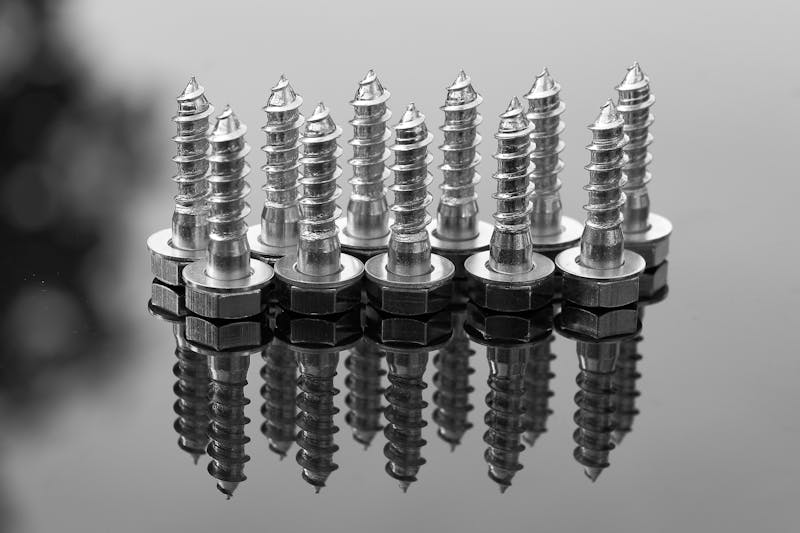
"One anchors machines; the other anchors identity—both shaped by spirals."
When you think of a screw and the human iris, they might seem like entities from entirely different worlds—one a cold metal fastener used in construction, the other a biological feature responsible for our eye color and vision control. Yet, beneath the surface lies a fascinating connection between these two: the spiral.
Spiral Geometry: Nature and Engineering Collide
The spiral is one of nature's most efficient and beautiful designs. Found in galaxies, seashells, and yes—both screws and irises—it’s a pattern that symbolizes growth, stability, and motion. Screws utilize spiral threads to convert rotational force into linear movement, anchoring objects with precision. The human iris, meanwhile, displays fibrous radial and concentric patterns—some with spiral characteristics—that open and close to regulate the amount of light entering the eye.
While their functions differ vastly, both structures rely on the spiral for a purpose: control. For screws, it’s the control of physical components; for the iris, it’s control over visual input. This shared geometry isn't coincidental—it’s a testament to how nature and engineering often arrive at similar solutions for entirely different problems.
Screws: The Quiet Backbone of Civilization
Screws have revolutionized everything from furniture to spacecraft. Their spiral threads allow for controlled penetration and secure fastening. Despite their simplicity, they are critical in maintaining the integrity of nearly all man-made structures.
Developed as far back as Ancient Greece, the screw’s design has remained largely unchanged. The helical thread distributes load and holds components tightly, making it irreplaceable. From carpentry to dentistry (yes, dental implants are essentially precision screws), their adaptability and reliability have turned them into silent workhorses of modern life.
The Iris: More Than Just Eye Color
The iris, often romanticized in poetry and photography, is far more than a colorful ring. It’s a muscle. Made up of two layers—the pigmented front and a muscular back layer—it adjusts the pupil size in response to light. Its patterns, especially when viewed under magnification, resemble intricately woven spirals and radiating fibers.
These patterns are unique to every individual—like fingerprints. In fact, iris recognition is becoming a popular form of biometric security due to its precision and resistance to change over time.
Design Mirroring: Biomimicry and the Spiral
Engineers often look to biology for design inspiration—a field called biomimicry. Spiral patterns, as seen in the iris, inspire efficient mechanical systems. The human eye's efficiency in handling pressure and light control has influenced optical device design, such as camera apertures and lens adjustments.
Likewise, screws have inspired bio-engineered implants, designed to mimic the body's natural resistance to pressure and movement. Orthopedic screws, for example, often include micro-textures that resemble bone structure to improve integration.
Where Function Meets Aesthetics
There’s also a deeper, aesthetic similarity. The spiral is not only functional—it’s visually captivating. Designers and artists often borrow this motif from both screws and irises. Whether it’s industrial design that highlights screw threads or digital art that mimics iris textures, this pattern captures the human fascination with order and complexity.
What This Overlap Teaches Us
At first glance, comparing a screw and the iris might feel like a stretch. But looking closer reveals a shared story of how form follows function, and how the spiral—a shape common to both—enables precision, stability, and control across both biological and mechanical realms.
It’s a reminder that great design often transcends categories. The spiral isn’t just a motif; it’s a universal solution—appearing wherever precision and beauty must coexist.