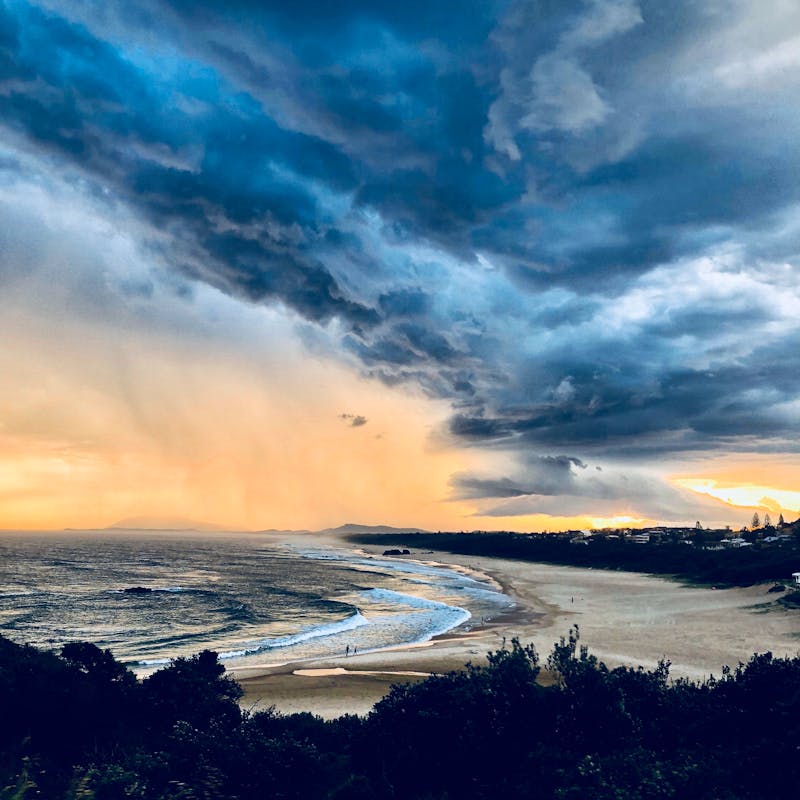
The sky has never promised permanence, only patterns we mistake for certainty.
We live as if the ground beneath us is a contract.
A home address, a familiar season, a shoreline that seems like it has always been there—these things feel like guarantees. Yet the planet has never been interested in keeping our schedules. It shifts, exhales, cracks, warms, cools, and rearranges itself with a patience that can look like stability until it suddenly doesn’t.
Under strange skies—smoke-tinted afternoons, winter days that act like spring, rain that arrives all at once—we’re forced to notice what we’d rather ignore: Earth is not a backdrop. It’s a restless participant.
When the Familiar Starts Looking Unfamiliar
Most people don’t wake up thinking about climate systems or tectonic plates.
They wake up to the ordinary: coffee, school drop-off, a train platform, the rhythm of messages and meetings. The world is supposed to be the steady part, the stage that holds still while our lives change.
But lately the stage has begun to move.
A day of heat that feels personal, pressing against the skin like a hand. A storm forecast that reads less like weather and more like a warning. A sunset made too vivid by particles in the air. Even if you can’t name the causes, you recognize the feeling: the atmosphere behaving differently, as if the sky has developed a mood.
The psychological impact is subtle at first.
You start checking the weather more often, not out of curiosity but out of vigilance. You notice how conversations shift: someone mentions air quality the way they used to mention traffic. A neighbor talks about replacing a fence after another “once-in-a-century” wind event—except it happened again.
Strangeness accumulates.
And when it does, it chips away at an assumption many of us carry quietly: that modern life has insulated us from nature’s volatility. In reality, modern life has simply made the volatility more legible.
The Old Story: Humans as Separate
For a long time, the dominant story in many societies has been separation.
Nature was “out there,” a place to visit, a resource to manage, a problem to solve. Even the language gives it away: natural disasters, natural resources, natural beauty—nature as object.
This story pairs well with technology.
If the world is a machine, then it can be tuned. If the ocean is a boundary, then it can be crossed. If land is inert, then it can be reshaped. If weather is merely a forecast, then it can be planned around.
But the planet doesn’t behave like a static machine.
It behaves like a set of relationships: oceans trading heat with air, forests trading moisture with clouds, ice reflecting sunlight, soils holding carbon, currents moving energy around the globe. Remove one piece and the entire system doesn’t collapse immediately; it adjusts. Sometimes that adjustment is gentle. Sometimes it’s abrupt.
The separation story has another flaw.
It invites a kind of moral loophole. If nature is “out there,” then harm is abstract. A warming trend becomes a graph, not a headache during a heat wave. A disappearing wetland becomes a statistic, not a lost buffer that once softened storms.
Under strange skies, abstraction gets harder.
The planet keeps tapping the glass.
A Restless Planet Isn’t a Broken Planet
Restlessness is not new.
Earth has always been dynamic: continents drift, rivers change course, climates swing over long time scales. The ground we build on is the result of ancient upheavals; the air we breathe is a balance struck through countless interactions.
What’s changed is the speed and direction of some of those shifts.
When human activity pushes more heat-trapping gases into the atmosphere, the system responds. When land is cleared, surfaces change—how much sunlight is reflected, how much water is held, how much carbon is stored. When oceans absorb extra heat, weather patterns can reorganize in ways that ripple outward.
It’s tempting to frame this as punishment.
But the planet isn’t judging us. It’s reacting.
That distinction matters because it alters what we do next. Punishment narratives often lead to despair or denial. Reaction narratives lead to responsibility: if the system responds to inputs, then inputs matter.
Not everything about a restless planet is catastrophic.
Change also produces new ecosystems and new opportunities, but those “new” conditions may be incompatible with the lives and infrastructure we’ve built. The tragedy is less about Earth becoming unlivable in any absolute sense and more about our specific way of living becoming poorly matched to the world we’ve helped reshape.
The Quiet Grief of Losing “Normal”
There’s a particular kind of grief that doesn’t get memorial services.
It’s the grief of a season that no longer behaves. The grief of teaching children the names of birds that no longer appear in the same months. The grief of realizing you can’t count on snow days, or on spring blooms, or on a cool night to relieve a hot day.
This grief is often lonely.
People worry it sounds melodramatic, so they keep it to themselves. They talk about the weather as small talk while feeling, underneath, that something important is slipping.
The loss of “normal” can feel like losing part of your identity.
Place is not just where you live; it’s how you understand yourself. A coastal town is a relationship with tides. A farming region is a relationship with rainfall. A city is a relationship with heat and shade, with infrastructure and the river beside it.
When those relationships change, the self changes too.
And that can make people defensive.
It’s not simply that change is inconvenient; it’s that change threatens a story: that the world you grew up in is the world your children will inherit. When that story breaks, it leaves a gap where certainty used to be.
Rethinking “Place” as Relationship
If there’s a way through strange skies, it begins with a different definition of place.
Place is not a coordinate on a map. It’s a set of exchanges: water moving through soil, shade moving across sidewalks, wind moving through streets, heat held by brick, carbon held by trees.
When you start seeing place as relationship, new questions appear.
Not “How do we keep everything the same?” but “What does this place need to stay livable?” Not “How do we dominate nature?” but “How do we participate without breaking the terms of the system?”
Participation is a humbler stance.
It recognizes that human comfort depends on ecological function. It accepts that resilience is not just a personal trait but a community and environmental condition. It makes room for adaptation without treating adaptation as surrender.
There’s a small scene that captures this shift.
A person stands in a neighborhood where a few yards have replaced grass with native plants. The air feels slightly cooler near the foliage. Bees move between blossoms. The street is the same street, but it’s also a different microclimate. It’s a reminder that the atmosphere isn’t only shaped by distant forces; it’s shaped by what’s right here, too.
The Myth of Individual Control—and the Reality of Collective Power
It’s easy to get trapped between two false options.
Either the problem is so large that nothing matters, or the solution is so personal that you can solve it with better habits. Both stories are incomplete.
Individual choices matter, but not because any one person can tip the scales alone.
They matter because they signal values, create demand, and build momentum. They matter because they can make a life feel coherent rather than fractured by helplessness.
But the bigger levers are shared.
Energy systems, building codes, transportation networks, land-use decisions, disaster preparedness, water management—these are collective choices. They shape whether strange skies become a temporary stressor or a long-term rupture.
Collective power is not always dramatic.
Sometimes it looks like a city planting trees with an urgency that suggests trees are infrastructure, not decoration. Sometimes it looks like neighbors checking on each other during a heat wave because resilience is also social. Sometimes it looks like a school redesigning outdoor spaces for shade and airflow, treating children’s comfort as a design requirement rather than an afterthought.
In a restless world, care becomes practical.
Learning to Live Without the Illusion of Stable Backdrops
The hardest adjustment may be internal.
We’ve trained ourselves to expect predictability and to interpret unpredictability as failure. But the planet is not failing when it changes; it is doing what systems do when conditions change.
What fails is our insistence that the world must hold still for us.
Rethinking our place means accepting that stability is a relationship we have to maintain, not a natural state we can assume. It means designing homes, cities, and economies for variability rather than for a single remembered climate. It means treating the future as something we shape through patterns of behavior, not as a fate that arrives all at once.
This doesn’t require constant dread.
It requires attention.
Attention to where heat collects in your neighborhood. Attention to how water moves after heavy rain. Attention to which trees thrive and which struggle. Attention to the people most exposed to the changes we’re noticing—because vulnerability is not evenly distributed.
Attention is a form of respect.
It brings the world back into focus as something alive, reactive, and intimately tied to our choices.
Under Strange Skies, a Different Kind of Hope
Hope is often misunderstood as optimism.
But optimism is a mood. Hope is a practice.
Hope looks like refusing to normalize harm, even when the harm is slow. It looks like making preparations that signal belief in a future worth meeting. It looks like telling the truth about what’s changing without turning that truth into paralysis.
Under strange skies, it may be wiser to aim for steadiness rather than certainty.
Steadiness is what you see in communities that adapt without losing their humanity—people who build shade, share resources, push for better policy, and keep paying attention even when the news cycle moves on.
The planet will continue to move.
The question is whether we keep pretending it won’t.
A restless Earth doesn’t mean we’re doomed to instability. It means we’re invited—firmly, repeatedly—to give up the fantasy of separation and take up the work of relationship.
And once you see yourself as part of the system, the sky no longer feels like scenery.
It feels like a message you can finally read.