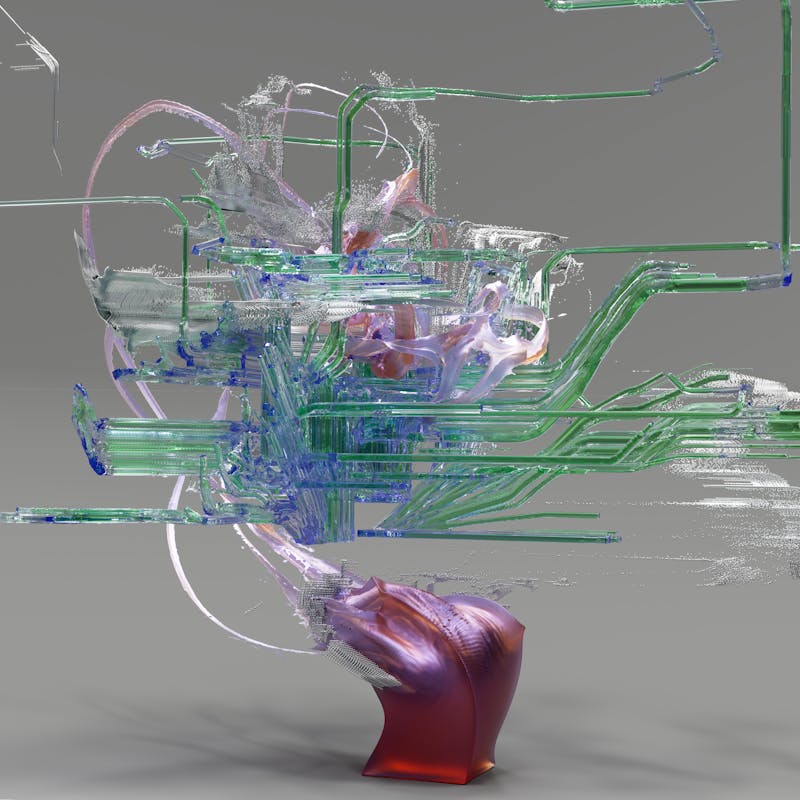
The internet is learning to rearrange itself.
A few years ago, “digital ecosystem” still sounded like a metaphor—an elegant way to describe platforms, apps, and services tangled together in our daily routines. Now it’s starting to read more literally. Software systems are beginning to observe their own behavior, rewrite their own rules, and recruit new components without a human project manager standing over the process. That shift won’t feel like a single invention that arrives with a drumroll. It will feel like the background changing: the way products evolve, the way companies organize, the way individuals experience technology.
The coming decade points toward self-designing digital ecosystems—networks of tools, agents, data streams, and interfaces that can adapt structurally, not just cosmetically. Instead of merely updating features, they’ll reconfigure workflows, shift incentives, and redesign the pathways through which people and organizations get things done.
When software stops being “built” and starts being “grown”
For most of computing history, design has been upstream from behavior. People decide what a system should do, encode those decisions, and ship a product that users then interpret in the wild. Feedback loops exist, but they’re slow. The world changes faster than the roadmap.
Self-designing ecosystems invert that tempo. They treat behavior as the raw material of design. They watch what happens—what users try, what fails, what takes too long, what gets abandoned—and they propose structural changes, sometimes making them automatically.
This can be as mundane as a help desk platform that reorganizes categories because it detects new recurring issues. Or it can be as consequential as a logistics network that reroutes inventory strategies and supplier relationships because it detects a pattern of disruptions. The novelty is not automation of tasks; it’s automation of architecture.
The language around this will be slippery. Some will call it “autonomous optimization,” others “AI-driven orchestration.” But the lived experience will be simpler: software that doesn’t just respond—it evolves.
The rise of digital ecology: agents, APIs, and incentives
A self-designing ecosystem is less like a single product and more like a small city. It has residents (users and automated agents), infrastructure (APIs, identity systems, data stores), and institutions (policies, permissions, governance). And like a city, its character is shaped by incentives.
In the next decade, automated agents will become regular participants in these environments. They’ll schedule meetings, negotiate service terms, request refunds, audit invoices, draft marketing variations, and coordinate between tools that were never designed to speak fluently to one another.
As agents proliferate, ecosystems will begin to design themselves around agent-to-agent interactions, not just human interfaces. The “frontend” won’t disappear, but it will stop being the primary stage where work happens. More decisions will occur in the connective tissue: background processes, event triggers, machine-readable contracts, and permissioned workflows.
That shift will force a new kind of design question. Not “Is this button clear?” but “Is this ecosystem legible?” Can its participants—human and machine—understand why something happened, who authorized it, and what tradeoffs were made?
Personalization becomes structural, not decorative
We’ve grown used to personalization that changes what we see: recommended videos, curated news feeds, product suggestions that feel a little too accurate. In a self-designing ecosystem, personalization will increasingly change what the system is.
Imagine a workplace suite that notices your team runs the same informal approval process every week—three people always weigh in, one person always consolidates feedback, and the same set of documents circulates. A self-designing system doesn’t merely offer a template. It might propose a new workflow, assign roles dynamically, and create a lightweight “micro-app” for that recurring ritual.
Or consider healthcare scheduling. Instead of a static portal that offers appointment slots, an ecosystem could restructure itself around patient behavior: offering automated transportation coordination, pre-visit forms timed to reduce drop-off, and adaptive follow-ups that respond to a patient’s pattern of adherence.
This is personalization as architecture. It’s more intimate than a recommendation engine, and potentially more helpful. It’s also more dangerous when mistakes occur, because structural changes can amplify harm.
Self-design needs something most tech avoids: constraints
The dream version of self-design is seamless: systems that improve quietly, like a garden that thrives with minimal tending. The reality will be thornier. Self-designing ecosystems will require constraints that are explicit, enforceable, and understandable.
Without constraints, optimization becomes a kind of tyranny. A system optimizing for “engagement” can become manipulative. A system optimizing for “efficiency” can become inhumane. A system optimizing for “profit” can become predatory. Those outcomes are not bugs; they’re what optimization does when the objective is narrow.
The next decade will likely push organizations to encode values into their ecosystems in a way that looks more like policy than product. It will feel less like choosing a feature and more like setting constitutional rules.
What counts as an acceptable tradeoff? What must never be automated? When does a recommendation require a human signature? What records must be retained for accountability? How do you prevent an ecosystem from optimizing one group’s experience by quietly degrading another’s?
The systems that matter most—finance, healthcare, hiring, education—will need strong “guardrails,” but the better metaphor is governance. Guardrails imply a single road. Ecosystems are networks of roads, and the governance needs to cover intersections.
The quiet shift from “apps” to “organisms”
A useful way to picture the coming change is to think about how apps are already dissolving. People spend less time “in” one program and more time moving through layered services: a message triggers a calendar update, a calendar update triggers a note, a note triggers a task, a task triggers a purchase approval.
Self-designing ecosystems will accelerate this dissolution. You’ll still download branded apps, but many experiences will feel like a fluid overlay that assembles itself around intent.
There’s a small scene that captures the difference.
Today: You open an expense app, find the right category, upload a receipt, and hope it routes to the right approver.
Tomorrow: You forward a receipt to your “work agent,” and the ecosystem decides whether it’s reimbursable, tags it correctly, requests missing details, and routes it through the approval chain it has learned your organization actually uses—not the one described in a dusty policy doc.
In that future, the “product” is not a single interface. It’s the living arrangement of rules, roles, and integrations.
New forms of lock-in—and new ways to escape it
Digital ecosystems have always created lock-in. Your photos live somewhere. Your contacts live somewhere. Your work history, preferences, and habits become deeply embedded.
Self-designing ecosystems could intensify this because the system will begin to mirror you. It won’t just store your data; it will store its own learned structure around your behavior. Leaving could feel like moving out of a house that rebuilt itself for your specific body.
At the same time, the same mechanisms that enable self-design could enable portability—if standards and incentives align. If workflows are described in machine-readable formats, if permissions are modular, if identity and reputation systems are interoperable, then you can imagine taking your “operating style” with you.
The tension will be political and economic, not merely technical. Companies benefit from friction. Users benefit from freedom. Regulators will care about competition. And ordinary people will care because switching costs are experienced as fatigue.
Creativity, but with a different kind of authorship
Self-designing ecosystems will reshape creative work in subtle ways. They’ll generate drafts, variants, and options faster than a human can. But the deeper change is that the system will start designing the conditions under which creativity happens.
A writing environment might notice you revise most heavily in the first 20 minutes, then lose momentum. It could restructure your workflow: hiding notifications, staging research in timed waves, and surfacing only the notes most relevant to what you tend to write next. A design tool might learn the feedback patterns of your team and preemptively produce versions that satisfy recurring critiques.
This can feel supportive, like a studio that knows your habits.
It can also feel invasive, like a manager who never stops watching.
In the coming decade, good creative ecosystems will likely be the ones that preserve a sense of authorship. Not just legal authorship, but psychological ownership—the feeling that your work still came from you, even if the environment helped shape it.
Trust becomes an interface
As ecosystems begin to redesign themselves, trust will stop being a marketing promise and start being an everyday interaction. People will ask, implicitly or explicitly: Why did the system change? Who decided? What did it optimize for? What did it sacrifice?
The most mature self-designing ecosystems will expose their reasoning in human terms. They’ll show the chain of decisions: what signal was detected, what options were considered, what constraints were applied, and what override is available.
This is not purely a transparency ideal. It’s practical. When systems become adaptive, users need handles. They need the ability to say, “Not like this,” without having to become engineers.
Expect new UI patterns built around contestability: buttons and controls that don’t just execute actions, but challenge them. “Undo” will expand into “roll back this policy.” “Report a problem” will expand into “this automation doesn’t fit my situation.”
The human role shifts to stewardship
There’s a familiar fear beneath all this: if ecosystems can design themselves, what’s left for people to do?
The answer is that self-design changes the human job from builder to steward. Builders focus on constructing a system according to a plan. Stewards focus on maintaining a system’s health over time.
Stewardship requires attentiveness to second-order effects: the way a small optimization can reshape behavior, the way a shortcut can become a loophole, the way an efficiency gain can become a quiet burden on someone else.
In organizations, this will likely create new roles that blend product thinking, ethics, operations, and governance. Not as performative committees, but as operational necessities—people whose job is to tune objectives, audit outcomes, and keep the ecosystem aligned with the institution’s purpose.
A decade defined by environments that can say, “I changed”
It’s tempting to imagine the next decade in terms of smarter tools. But the more interesting possibility is smarter environments—digital spaces that can reorganize themselves and then account for that reorganization.
The best versions will feel like walking into a well-run place: you sense that things have been arranged thoughtfully, that the space anticipates your needs without treating you like a predictable object.
The worst versions will feel like living inside a system that keeps moving the furniture and then denies it happened.
We’ll learn, collectively, that self-design is not a magic trick. It’s a negotiation between autonomy and accountability. Between adaptation and stability. Between what a system can optimize and what a society is willing to allow.
The coming decade won’t ask whether digital ecosystems can redesign themselves. It will ask whether we can build the kind of stewardship—technical, cultural, and institutional—that makes that redesign worth living with.