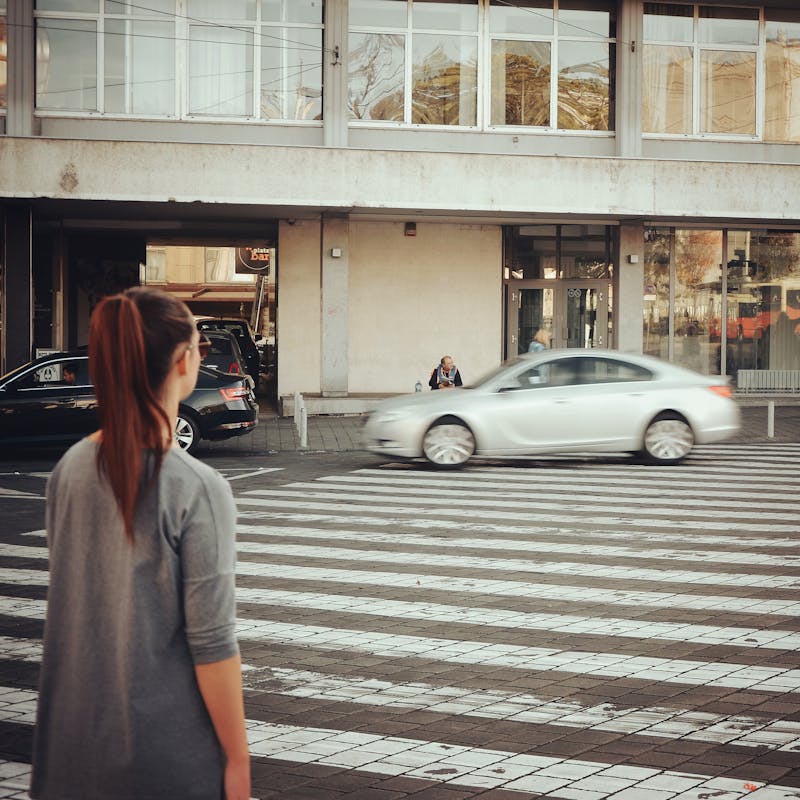
For a few seconds, a painted line turns into a small shared world.
The crosswalk is one of the last places where strangers regularly synchronize without planning to. Two people step toward the same curb from different directions, pause at the same edge, and—if the signal cooperates—move forward together as if choreographed. It’s mundane enough to ignore, yet intimate enough to feel.
Most of the time, we’re trained not to notice it. We keep our eyes on the light, our phones, the far sidewalk. We think of crossing as a logistical problem: timing, traffic, right of way. But the crosswalk is also a brief experiment in trust, in attention, in how we treat one another when the stakes are small but real.
The quiet choreography of waiting
There’s a specific kind of stillness at a crosswalk. It’s not the restful kind you get in a quiet room. It’s alert, angled toward the street, full of little recalculations.
You can feel it in the way people stand: half-turned toward the road, toes near the curb but not over it, shoulders slightly forward as if readiness is a physical posture. Everyone looks like they’re waiting for permission, even if they would never describe it that way.
And then there are the micro-decisions. Do you press the button, even if someone already did? Do you stand beside the person who arrived first, or behind them? Do you make eye contact with the driver rolling up to the stop line, or do you keep your gaze neutral, letting the rules speak for you?
These choices are tiny, but they aren’t nothing. They’re the first stitches in the invisible thread that forms between you and the people beside you.
Small signals, big meaning
At a crosswalk, communication rarely arrives as language. It comes as a glance, a tilt of the head, a half-step.
One person leans forward, and suddenly everyone is leaning forward. Someone takes one foot off the curb, and the whole group tightens, ready to follow—or ready to pull them back with silence.
Drivers and pedestrians negotiate too, using a vocabulary made of brake lights, speed changes, and hand gestures. A driver slows early, and it feels like courtesy. A driver slows late, and it feels like risk. A wave from behind a windshield can land as kindness or as performance, depending on how safe it feels.
The street is where we discover that rules are not the same thing as care. You can have the right of way and still feel uneasy. You can have the green light and still look both ways, because being correct doesn’t stop a moving vehicle.
The invisible thread of shared vulnerability
Crosswalks flatten people into the same category: pedestrian. For a moment, job titles and social roles don’t matter. Everyone is made of the same soft materials walking next to metal and momentum.
That’s part of what makes the thread feel real. It’s not romantic or mystical. It’s practical.
If you’ve ever crossed beside an older person whose pace is slower than the signal allows, you’ve felt the thread tighten. People adjust without discussing it. Someone slows down so they’re not rushing them. Someone else moves slightly outward, creating a buffer from the nearest lane. A third person steps forward at the end and glances back, as if to make sure the group is intact.
No one calls it solidarity. But it is.
And then there’s the opposite: the person who barrels through, head down, leaving others to scramble. The thread snaps, and you feel it as irritation, yes, but also as grief—a small reminder that not everyone agrees to the same social contract.
When the city teaches us how to treat each other
Every crosswalk is a lesson in what a place values.
In some neighborhoods, the crosswalk feels ceremonial: clear markings, longer walk signals, cars that stop with room to spare. In others, it feels like a dare. The paint is faded, the curb ramps are chipped, the turning lane behaves like a suggestion.
These details shape our behavior over time. Where crossing feels safe, people lift their eyes. They notice each other. They can afford to be generous with attention.
Where crossing feels dangerous, people become tactical. They step quickly, glance sharply, and keep their bodies tight. Survival narrows the mind. It’s difficult to feel connected to strangers when you’re busy calculating whether the driver sees you.
The built environment quietly edits our humanity. It can make cooperation feel natural, or it can make it feel naïve.
The strange intimacy of not speaking
There’s a particular closeness in standing beside someone and never exchanging a word.
You hear their breath in cold weather. You catch the scent of laundry detergent or cigarette smoke. You notice the rhythm of their foot tapping while the light stays red too long.
Sometimes you witness a private moment that isn’t meant for you: a parent murmuring to a child, a person checking their reflection in a dark phone screen, someone rereading a text with a face that briefly collapses.
None of it becomes your business. But it becomes part of your day.
Then the signal changes, and you start walking at the same time. A short-lived partnership forms, based on nothing but proximity and a shared need to get across. It’s oddly hopeful. It suggests that we can align without agreement, move together without knowing anything about each other.
The ethics of pace
Crosswalks reveal how we handle differences in speed.
The fastest walkers often treat the crosswalk like a lane of their own, weaving through slower bodies with impatient precision. The slowest walkers sometimes look apologetic, as if taking up time is a moral failure.
But a crosswalk is not a race. It’s a negotiated public space, and pace is an ethical choice as much as a personal habit.
When someone chooses to slow down for another person, they’re making a quiet statement: I won’t make your body feel like an inconvenience. When someone chooses to squeeze past, they’re making a different statement: my schedule outranks your comfort.
Neither person is purely good or bad. People rush for reasons. People move slowly for reasons. The crosswalk just makes the reasons visible in motion.
The moment the thread becomes visible
Every so often, something small turns the invisible thread into a line you can actually see.
A driver stops early and decisively, and the whole corner relaxes. A pedestrian nods in thanks, and the nod is returned, and suddenly there is a complete circuit of recognition: I see you seeing me.
Or a near-miss happens. Tires whisper too close to the paint. Someone flinches. Someone else mutters something under their breath that isn’t quite anger and isn’t quite fear.
In that instant, strangers often become allies. People glance at each other as if to confirm what they all felt: that was too close. The shared jolt creates a temporary community.
It’s startling how quickly we can become “we.” It’s also startling how quickly we return to “me” once we’ve reached the other side.
What we carry across, besides ourselves
A crosswalk doesn’t just move bodies. It moves moods.
If a driver refuses to yield, you carry the residue—tight shoulders, a sharper walk—into whatever comes next. If someone steps aside to let a stroller pass, the gesture can soften you for the next hour. You might hold a door longer. You might let someone merge. You might look up.
These aren’t grand transformations. They’re small adjustments in the temperature of a day.
It’s easy to underestimate how much of our emotional life is shaped by tiny interactions with people we’ll never meet again. The crosswalk is one of the most reliable places those interactions happen, precisely because it forces us into shared timing.
A crosswalk as a civic mirror
If you want to know what a community feels like, don’t start with its slogans. Stand at a busy intersection.
Watch who is protected and who is rushed. Notice whose presence changes the behavior of drivers and whose doesn’t. Pay attention to whether the city has designed the crossing for the most agile among us or for everyone.
The crosswalk reflects more than traffic patterns. It reflects patience, urgency, trust, and the quiet hierarchies we pretend aren’t there.
And it reflects something else too: our capacity to cooperate without being asked.
The reflective ending: stepping off the paint
When you reach the far curb, the spell breaks. People scatter into their separate lives like drops of water sliding off glass.
But the thread doesn’t vanish completely. It lingers as a faint sense that your life is continually brushing up against other lives, not in dramatic collisions but in soft, repeated contact.
The crosswalk asks for a simple kind of courage: to be present, to be readable, to treat the people beside you as real. It also asks for a simple kind of humility: to admit that you depend on strangers more often than you notice.
Next time you’re waiting for the signal, try looking up—not to stare, not to invade, just to register the shared moment. The painted lines won’t change, and the traffic will keep moving.
But for a few seconds, you’ll feel it: the invisible threads between us, tugging lightly as we step forward together.